
On February 25, City Council’s Infrastructure & Environment Committee spent part of its meeting that day discussing Toronto’s Ravine Strategy, and hearing from a number of groups that are active in ravine advocacy. Midtown Ravines Group Chair John Bossons was among the deputants to appear at the committee. The ravine discussion was agenda item IE27.7, and additional information on the meeting can be found on the I&E Committee’s web page. (Access the I&E Committee Ravine Material)
The statement by John Bossons can be found at the 4:43:30 mark of the following video record of the committee meeting (note: the beginning of John’s statement was not included in the recording). John’s statement is followed by a discussion involving Councillor Dianne Saxe. A transcript of John’s deputation statement is provided below the video.
Deputation by John Bossons for the Midtown Ravines Group
Chair and members:
The Midtown Ravines Group (MRG) is a consortium of ten residents’ associations in Midtown Toronto focused on restoring and improving ravines in our neighbourhoods. We are strong supporters of Toronto’s Ravine Strategy, applaud the work that Parks and Urban Forestry have done in advancing its implementation, and advocate for investing more resources in the restoration, protection, and enhancement of Toronto’s ravines.
Plan for the Vale of Avoca
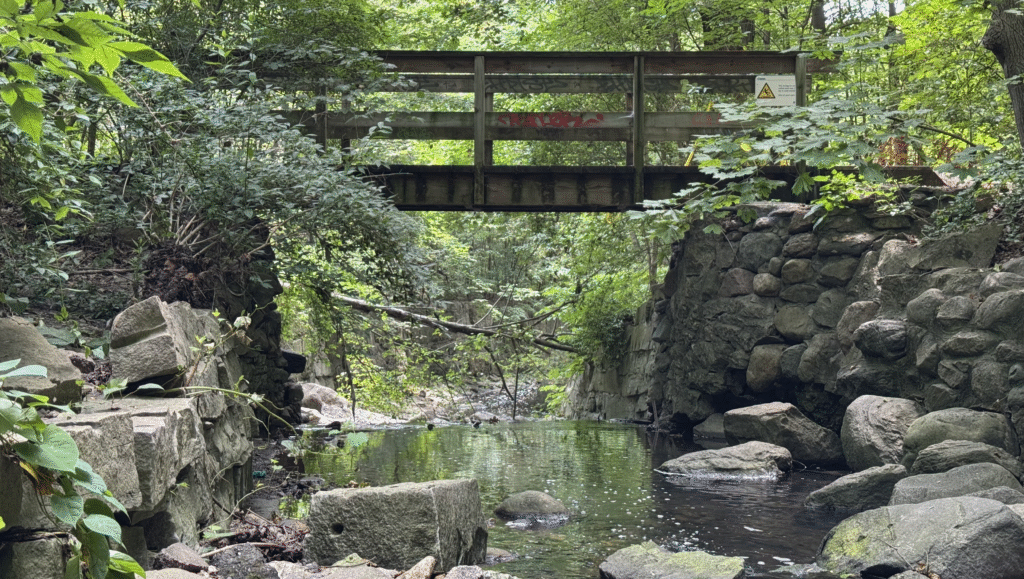
A particular focus of our efforts is the restoration of the Vale of Avoca, one of the ten ESAs identified for priority investments in the Ravine Strategy implementation plan. We have developed a Community Vision Plan that is now being evaluated and turned into a fully engineered Master Plan for erosion control and trail layout, funded by a $1.5 million budget approved by City Council last July.
Back in the 19th century, the Vale of Avoca was a destination park for citizens of the then City of Toronto, maintained and improved by substantial public and private investment. Unfortunately, this investment was not maintained or upgraded over the years, and climate change has made the effects of erosion dominant. Our back-of-the-envelope calculation is that a capital investment of on the order of $30 million will be required to bring the Vale of Avoca back to a modern version of the standard set in the 19th century.
In order to meet that challenge, we are – with City support – organizing a public/private partnership through which we can raise the necessary funds. The City has committed $6 million in future capital spending towards the work that will be required, making clear its commitment to the partnership. We are in the process of raising money from private donors to obtain the necessary additional funds.
In doing so, we are liaising with Evergreen and other potential partners in the Loop Trail project. The Vale of Avoca is a key component of a Loop Trail Midtown connector, extending through ravines and the Belt Line from as far west as Eglinton and Caledonia to the Loop Trail at the Brickworks.
We believe the public/private partnership we are organizing provides a model that can be implemented elsewhere in the City. With the City’s population expected to grow by a million more residents over the next 25 years – 100,000 in the nearby Yonge corridor – it is vital that partnerships like ours be formed to expand the natural and recreational resources that will be needed by that population.
Protecting and preserving Toronto’s ESAs
We welcome the work being done by Urban Forestry to enhance Toronto’s ESAs. Indeed, we have a strong local interest in this work because most of the Vale of Avoca is an ESA. We are keen to provide resources that will expedite the development of an effective ESA Management Plan for the Vale.
In this connection, we would like to stress the evolving potential importance of citizen stewardship. With Toronto Nature Stewards as partners, we are keen to see citizen stewardship initiatives used as means of expanding what can be accomplished. The City’s budget is limited, and the work that is required exceeds what is presently being accomplished. Just as private resources are needed to supplement the City’s ravine capital budget, so citizen stewardship is needed to supplement Urban Forestry’s operating budget. We believe that volunteer-led stewardship is a critical resource for achieving the City’s objectives for ecological remediation, not only to augment limited City resources but also to engage community interest in the valuing and protecting of our ravine spaces.
We are currently raising money to fund summer student interns undertaking research in the Vale of Avoca ravine, seeking to update the inventory of invasives and threatened native species done by the TRCA in 2013. We seek to build on this by helping to fund other work leading to an ESA Management Plan that incorporates private support and, where feasible, community-led stewardship. We believe trained citizen volunteers can make an invaluable contribution to the ecological integrity of ESAs and look forward to working with Urban Forestry and Toronto Nature Stewards to make that possible.
Summary
There is much that needs to be done, not only in the Vale of Avoca but throughout the City. While we applaud the work being done by Parks and by Environment and Urban Forestry, the need is far greater than what is currently being funded by City Council. The City needs to do much more – both through greater budgetary support and through innovative partnerships and stewardships of all types – to expand what it is doing to protect and enhance Toronto’s ravines.